Parenting & Professing

I confess, I freaked out a bit when I first heard about this book. My Mama, Ph.D. co-editor, Elrena Evans, and I had done a fair amount of research already into the literature of parenting in the academy and hadn’t come across this title. Then I looked at the table of contents and found its section titles suspiciously close to the titles we’d devised (P&P; got them first, so we’ll have to change).

But now that I’ve read the essays in this book, I’m happy to report that there’s room in the world for the two collections. The essays in P&P; are thoughtful and well-researched, sometimes quite moving, often positively jaw-dropping. Fathers and mothers are both represented here, single parents, adoptive parents and grandparents; students, adjunct faculty, tenured faculty and administrators. But this is definitely an academic book, by which I mean a book written by academics for other academics. (My writing group continually reminds me not to take my academic language for granted; “What do you mean by the academy, anyway?” they ask.)

While Parenting and Professing‘s introduction very convincingly situates the problem of combining work and family in the broader context of the American workplace (as Mama, Ph.D. will), none of the essays take up that issue, or, I think, appeal to a reader who is not grappling with the problem of combining academic work with a family. I hope Mama, Ph.D. will. Stay tuned.

Milestones In My Not Becoming a Rock Star

1973: Anne and I play Magic Garden in her backyard. For those of you who don’t remember this PBS kid’s show, it featured two singers, Carol and Paula, kind of the apolitical, vanilla Indigo Girls of the 70s, doing skits and singing at the base of fake tree with a squirrel puppet named Seymour. Carol had beautiful blonde, wavy hair and a pretty name. Paula had mousy brown pigtails and, well, was named Paula. But she did play the guitar. Playing Magic Garden involved, basically, fighting over who got to be Carol. I argued that my name gave me the stronger claim. I don’t recall us getting much past this dispute into any kind of game.

1979: Jennifer and I aspire to be backup singers. We can sing pretty well (we can certainly do-wop ok), we figure we can wear the cute outfits, dance around, and shoulder none of the responsiblity of fronting a band. We practice in her family’s basement TV room.

1981-85: In high school, I sing in the chorus for performances of Oklahoma! and Guys And Dolls.

1988: Junior year at Oxford, Robin and I buy tickets to see Bruce Springsteen at London’s Wembley Stadium. We’ve been singing the songs off Tunnel of Love all spring, and cook up an elaborate plan to sneak backstage to meet The Boss. At the last minute, we discover the show is all carnival seating and we chicken out.

That summer, my sister and I go see Mel Torme at the Hollywood Bowl.

2006: I learn that a former “faculty brat,” the daughter of my high school history teacher, is a contestant on Rock Star Supernova. I have to tune in.

I’d known that Storm (really; and her last name is Large) was a rocker. We’d run into each other on the NYC subway in 1991; I was on my way to publishing job, she was on her way home from a gig. On my wedding night, I discovered that she was playing the club next door to our hotel, and briefly considered going in to dance in my wedding dress. Now here she is, in the final five of a reality show where the contestants compete to become the lead singer of Supernova, a band fronted by Tommy Lee.

I love it. The guys in Supernova, who are probably around my age but wear their years hard, say “chick” and “dig it” without irony, and a weak performance is “sauteed in wrong sauce.” They make me feel young. The contestants (2 women now, and 3 men), meanwhile, who are pierced and tattooed and wear more eye shadow in one night than I will in my lifetime, make me feel very old, very much a mortgage-paying, carpool-driving, sectional-sofa-sitting, tv-watching mom. And the music, some Bowie and the Beatles, but also a lot of stuff I don’t know, the music isn’t really my music anymore. But I don’t care, because they are really fun to watch. I don’t think Storm will win; I think either the hot Aussie guy or the soulful Icelandic dad will beat her out. Still, I’ll watch as long as she’s up there rocking because she can belt out a song, and I knew her when she was ten, and she’s as close as I’m getting to any rock star.

Clean Sweep

If someone from the New York Times photo desk called to set up a shoot at your house, how fast could you be ready? I have a couple friends neat enough that they could spend the time arranging flowers. Not me. But thanks to deep kitchen drawers, Method wipes and a Swiffer, we were photo-ready in 45 minutes.

The back story: a writer friend’s writer friend interviewed Tony for an article on green renovations. If we’re lucky, they’ll illustrate the piece with a picture of Eli, sitting on the bottom shelf of the kitchen island, eating his sunflower seed butter sandwich.

Terms of Endearment

Sometime last year I started calling Eli “turkey” and the nickname has stuck. Perhaps I was influenced by the mom in The Squid and the Whale, who called her youngest “chicken.” Whatever, it’s pretty appropriate, really, given his size. But Ben has come up with a nickname I like even more: Big Face. “Hi, Big Face!” he greets his big little brother. It suits him even better than Turkey.

Safe

I had to stop watching E.R. when I was pregnant with Ben. The September 11th attacks had just happened, and I was all too cognizant of the dangers of the world. I didn’t need to invite them into the living room.

I had to stop saying “Drive safe” to Tony when he headed off on his 45-minute commute. After a few months of the ritual, he worried how I’d fret if I missed my chance one day, how guilty I’d feel if somehow my ritual words failed to protect him.

I had to stop stepping directly in to crosswalks, insisting bodily on my right of way, when I started pushing a stroller in front of me. “You can be right,” remarked my reasonable husband, “Or you can be safe.”

I had to tell Ben last spring that a child in his preschool had died in an accident.

I had to watch yesterday, my heart in my mouth, as a mad driver swerved toward a dad walking his son into our preschool. I was a few steps back. We’d both heard the crash behind us as the driver hit a car, the squeal of the tires as he pulled away, and the scream of a police car’s siren. The siren made me feel momentarily safe, until I looked back and saw how cautious the police car was in pursuit, until I saw the other car, its front end smashed, race up the street toward us. The dad scooped his son up into his arms. I pushed Ben and our carpool companion behind me, then hustled them onto the ramp in front of the school, which is protected (somewhat) by a metal railing. Ben and his buddy were delighted; they love to run up and down that ramp after school, playing a game they call “Dong!” I kept an eye on the car–which had strangely, thankfully, swerved away from our schoolmate, roared up the street, but then u-turned and headed back toward us–as I hurried the boys into school. I was glad it was my school workday, so I didn’t have to say goodbye to the boys but could stay and play. They never knew that for a moment, for them, it hadn’t been safe.

I have to think today of all the people who weren’t safe yesterday, and hope that those who survived will heal.

I live in earthquake country. I’m a parent. I don’t need to read the paper to know, really know, that I’m not safe. I don’t dwell on it; we keep earthquake kits in the car and garage, we have an emergency plan. But I don’t much like to be reminded of it, either. When danger swerves so close, it makes me want to gather the family close and hunker down.

After 9/11, after the tragedy last spring, we gathered friends around the dinner table. Yesterday, I came home to find Tony, unaware of the news, frying tofu, boiling noodles, steaming vegetables — making a fabulous meal. I’d brought (a different) one of Ben’s preschool friends home, and she and her parents wound up staying for supper. After those scary moments earlier in the day, sharing a meal together made me feel truly safe.

20Something Essays by 20Something Writers


Who even remembers their 20s?! Now on the cusp of forty, I’ve been reminiscing about my thirties a lot. It was a good decade: I earned my PhD, married my husband, had two kids, and started to publish my writing.

But my twenties, though I was happy to be out of them at the time, were a good and productive decade, too. After all, that’s when I moved to California and started graduate school, lived on my own for the first time, did all the work for my doctorate, and met my husband just weeks before I waved hello to thirty.

The writers in this great collection aren’t thinking too much about thirty right now–they are keeping way too busy for that. Raising kids; nursing a boyfriend through terminal illness; maturing in Kuwait; working at Wendy’s; learning to dance with their OCD; logging on to Friendster, Facebook, MySpace and Nerve accounts — they’ve got a lot going on, and it was fun to check out of my life for a bit and listen in on theirs.

My favorite essay, of course, is Elrena Evans‘ “My Little Comma,” first published in the section I co-edit over at Literary Mama. I’ve read this essay, in various versions, over a dozen times in the past year and it never gets old. This is my favorite section today:

I just got off the phone with my advisor, and if my daughter weren’t watching me, I swear I would spit. The pressure is on, he admonishes me: finish your project or lose our funding. I wonder: if he knew how close I was to leaving, what he would say? I wonder what would happen if I left in the middle of the year, just scooped up my plump little baby and left. I wouldn’t wait until the end of the semester to go, and I wouldn’t leave everything tidied up behind me. I’d simply up and leave, tear myself out of the university and leave a gaping, jagged hole in my wake. My spine prickles guiltily at the thought. What a lovely mess I would make. Part of me just wants to say “I don’t care” and wait for the lion to eat me.

Meanwhile, the conversation about mothering and graduate school that Elrena’s essay started is turning into a book (stay tuned to see how it all turns out!)

Other essays I particularly loved… Jess Lacher’s “California” reminded me of how strange and unfamiliar it all seemed when I first arrived here myself: the “gentle and mysterious suggestions” of the seasons; the intense and exotic plants; the sense of being on a “vacation life” (yeah, that ended for me a while ago). Emma Black writes about teaching elementary school and learning how to “Think Outside the Box But Stay Inside the Grid.” For the sake of her students, I hope she keeps trying. Radhiyah Ayobami spends “An Evening in April” getting a treat for her son before the curfew at their shelter; they give some change to a woman on the corner, and Ayobami imagines someday going to the park with this stranger and her kids: “People would look at us, and instead of seeing two beggars, they’d see two mothers with children, and they’d smile. I had big plans for that woman, if only I could see her again.” In Shahnaz Habib’s gorgeous “Backlash,” written the day of the bomb blasts in Delhi, she worries about an old friend and thinks sadly of the secret relationship they have now lost.

When I started reading this collection, I was thinking I don’t know too many people who are in their twenties, but now I kind of feel like I do. That’s some fine writing.

Mom’s Fruit Crisp

There are lots of delicious things to do with fresh fruit, but this is one of my favorites, and it’s also just about the easiest. Despite all the baking I do, I can never remember a recipe well enough to make it without referring to the recipe (or sometimes a couple of recipes); this is one simple enough that I can do it by heart. It scales easily, so you can make it for two or for a crowd. I’ve been making it since I was about 8 years old, and although every once in a while I’ll try a different recipe, just to see if there’s something I’m missing, I keep coming back to my Mom’s.

I’ll give you the recipe for 6 peaches (approx. 6 cups of sliced fruit); use more or less fruit and adjust your topping amounts accordingly. Of course, you can also make this with apples (peeled or not), nectarines, plums, pears, some berries, etc.

for filling:
6 peaches
1 tbsp lemon juice (or juice of one lemon)
1/2 tsp cinnamon

for topping:
1/2 c butter (1 stick)
1/2 c flour
1/2 c oats
1/2 c brown sugar
1/2 c wheat germ
1 tsp cinnamon

Preheat oven to 375.

Peel and slice the peaches. Pour into a shallow gratin dish and sprinkle with lemon juice and cinnamon.

Melt the butter in a container big enough to mix the crisp topping. Add remaining ingrediants and stir well with a fork. Sprinkle over fruit, and bake until browned on top and bubbling around the edges, about 40 minutes.

Team Player

Tony and I met with a financial advisor today. He was recommended to us by our tax guy. The fact that we have a tax guy, someone we pay to do our taxes, makes me feel more grown-up than the fact that I have a mortgage. Or kids.

But I digress. It was a very boring meeting, and he used a lot of jargon I didn’t understand, but it seemed important that I attend, and look, shall we say, present. So I tried. Good student that I am, I started to take notes. But it’s hard to take notes on information you don’t entirely comprehend. So then I started jotting down ideas for my next column. Then I tuned in to the meeting again and started writing down the sports metaphors he used. I wish I’d done this from the beginning, so that I could offer you a complete list, but he did pretty well in the last half hour:

That’s our bogey…

We won’t try to swing for the fences…

It does you no good to have a roller coaster ride…

We wade into the pool, we don’t dive in the deep end…

We’ll keep these positions covered…

We’re meeting another such person next week; will it be sports metaphors again? Can we choose an advisor based on their figurative language?

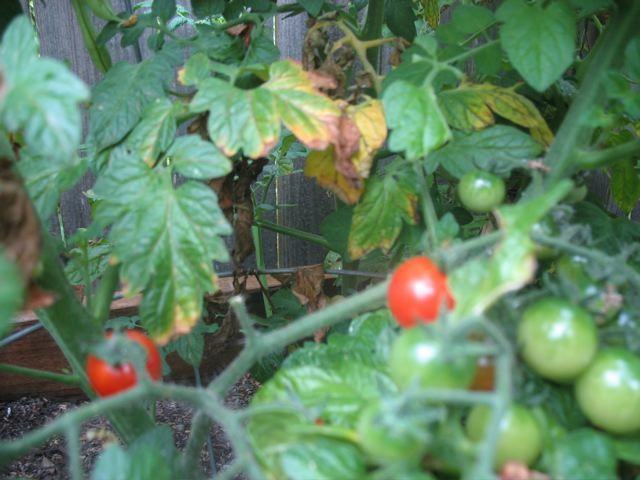
Proof of Global Warming


Al Gore’s movie is pretty convincing, but this has put me over the edge:

Ripening tomatoes in our foggy garden.

Time to start researching solar panels…

Something Sweet To Do With Bread Dough

Are you making ricotta cheese yet? And saving the resulting whey (previously, and less appetizingly referred to as the thin, milky liquid that drips off the cheese) to bake with? If I tell you can make cinnamon rolls really, really easily will you make them? I must credit my mom here, who on a recent visit reminded me how effortlessly this can be done.

OK, you don’t have to start with ricotta cheese. But do start with this bread recipe; then, when the dough’s risen once and you’re ready to shape loaves, make one loaf of nice sandwich bread, and one nice pan of cinnamon rolls. Or skip the loaf entirely and make a whole lot of cinnamon rolls, I won’t tell.

Sponge
2 tbsp dry yeast
1/2 c lukewarm tap water
2 c warmed buttermilk (or the liquid that drained off your homemade ricotta cheese)
2 c unbleached bread flour

Dough
2 tbsp melted butter
1 tbsp honey
2 tsp salt
3-3 1/2 c unbleached all-purpose flour
2 tsp olive oil or more melted butter

Combine water and yeast in a large glass or ceramic bowl. Add the buttermilk and bread flour
and stir well. Cover with plastic wrap and let ferment overnight at room temperature. It may bubble up and then fall — that’s fine. In the morning, it will be bubbly and fragrant.

In the morning, add the butter, honey, and salt to the sponge and mix well. Stir in flour until the dough is smooth and pulls away from the sides of the bowl.

Rub your hands with oil or melted butter and lift the dough out of the bowl onto a lightly floured surface. Knead once or twice. Now let it sit a minute while you rinse out the mixing bowl with warm water, towel dry, and coat with olive oil. Put the dough in the oiled bowl, cover with oiled plastic wrap, and let rise about 1 hour.

At this point, you can butter or oil either two 8 1/2 x 4″ loaf pans, or one loaf pan and one 9×9″ square baking pan (the one you use for brownies), or a larger, lasagne-size, roasting pan. Just use metal pans; glass ones don’t give you as nice a crust.

Divide the risen dough in half. To make sandwich bread, form the dough into a vaguely loaf-like shape (really, you can pretty much drop the dough into the pan and it will find its shape), place in the pan, cover and let rise until the dough reaches the rim of the pan, about 30 minutes.

To make cinnamon rolls, take your half lump of dough (even if you’re turning all the dough into cinnamon rolls, working with half the dough at a time makes life easier), and roll it out into a rectangle, about 12″ long. Dot it with butter, then sprinkle brown sugar and cinnamon on top (or you could mush the butter, sugar and cinnamon up together in a bowl and spread it on the dough). Do this to suit your own taste; I used about 2 tbsp each of butter and sugar, maybe a teaspoon of cinnamon. Toss on a bit of orange zest if you have it, and sprinkle with raisins and/or walnuts if you like. Roll the dough the long way into a cylinder, and slice the cylinder into 3″-thick slices. Lay the slices in the baking pan cut side down, cover and let rise about 30 minutes.

Preheat oven to 420. Bake for 25-40 minutes. Check for doneness by turning one loaf out of the pan and tapping the bottom; if it sounds hollow, it’s baked through. For the rolls, check by lifting up a corner and seeing if the bottom is crusty and brown. If the breads are browning too much but don’t seem quite done, cover loosely with foil for the final 5-10 minutes of baking. Cool on a wire rack.